The remaining 20% of settlement funds is paid directly to participating cities and towns according to Exhibit A of Rhode Island’s state-local agreement.[1]
Participating cities and towns are encouraged to pool their funds,[2] and each may also direct their shares to the state.[3]
In general, and with limited exceptions,[4] this share must be spent on the approved purposes described in the national settlement agreement’s (non-exhaustive) Exhibit E,[5] which includes prevention, harm reduction, treatment, recovery, and other strategies.
Though local governments are encouraged to use monies on forward-looking strategies,[6] they may use their shares to reimburse past abatement expenditures if those reimbursement uses are documented through a resolution or equivalent action.[7]
Local governments decide autonomously. Decisionmakers for the cities and towns will ultimately decide for themselves how to spend their monies on Exhibit E uses.[8]
No, supplantation is not prohibited. Like most states, Rhode Island does not explicitly prohibit supplantation uses of its opioid settlement funds. This means that City and Town Share may be spent in ways that replace (or “supplant”) — rather than supplement — existing resources.
Up to each locality (neither public nor intrastate reporting required). Opioid settlement expenditures are not officially published in a centralized location for this share.
Visit OpioidSettlementTracker.com’s for an updated collection of states’ and localities’ available expenditure reports.
Not applicable.
(“20% directly to the Participating Cities and Towns (‘City and Town Share’) for Approved Purposes in accordance with Section III below”), (“Exhibit A … assigns each Eligible City or Town a percentage share of funds”), (defining “Participating City or Town” to mean those that are signatories to the MOU and participants to the settlement agreements, with the following cities and towns listed as explicitly eligible in : “Barrington, Bristol, Burrillville, Central Falls, Charlestown, Coventry, Cranston, Cumberland, East Greenwich, East Providence, Exeter, Foster, Glocester, Hopkinton, Jamestown, Johnston, Lincoln, Little Compton, Middletown, Narragansett, New Shoreham, Newport, North Kingstown, North Providence, North Smithfield, Pawtucket, Portsmouth, Providence, Richmond, Scituate, Smithfield, South Kingstown, Tiverton, Warren, Warwick, West Greenwich, West Warwick, Westerly, and Woonsocket”). ↑
(“Participating Cities and Towns may, and are encouraged to, share, pool, or collaborate on opioid abatement efforts with their respective allocation of the City and Town Share in any manner they choose”). ↑
(“Qualifying expenditures may include reasonable related administrative expenses”) and (defining “Opioid Settlement Funds” to exclude “funds needed to pay an administrator or a Rhode Island Qualified Settlement Administrator, or designated by a Settlement Agreement or court order for State or Participating Subdivision attorneys’ fees and costs”).
See also (“The Parties agree that attorneys representing the Participating Cities and Towns in litigation against the Opioids Defendants will satisfy any contractual obligations relating to those legal representations through the mechanisms provided for in the Settlement Agreements. Notwithstanding the provisions of part B of this subsection, no portion of the City and Town Share shall be used to pay any attorneys’ fees, costs, or other contractual obligations relating to legal representation in litigation against the Opioids Defendants”). ↑
("'Approved Purposes' means care, treatment, and other programs and expenditures designed to (1) address the misuse and abuse of opioid products; (2) treat or mitigate opioid use or related disorders; or (3) mitigate other alleged effects of, including on those injured as a result of, the opioid epidemic as identified by... Exhibit E ... or any other relevant Settlement Agreement"), ("All Opioid Settlement Funds, regardless of allocation, shall be utilized solely for Approved Purposes"). ↑
(“The City and Town Share shall be used for Approved Purposes and the Parties intend for the Opioid Settlement Funds to be used on forward-looking opioid abatement efforts”). ↑
(“But, the City and Town Share may also be used for past expenditures so long as the expenditures were made for Approved Purposes and are not otherwise restricted by a confirmed plan in a bankruptcy proceeding. Prior to using any portion of the City and Town Share as restitution for past expenditures, a Participating City or Town shall pass a resolution or take equivalent governmental action that explains its determination that its prior expenditures for Approved Purposes are greater than or equal to the amount of the City and Town Share that the City or Town seeks to use for restitution”). ↑
(providing for cities’ and towns’ direct receipt of shares, responsibility for their approved uses, ability to collaborate amongst themselves, redirect their shares, and otherwise describing their autonomous uses of funds). See also . Rhode Island Attorney General Presentation. August 2, 2022. Accessed August 25, 2024 (see “”). ↑
Here are the entities that ultimately decide how each of Rhode Island’s opioid settlement shares are spent:
80% statewide abatement share:
20% city and town share: local officials for cities and towns
Rhode Island’s 80% statewide abatement share is held in the Rhode Island Statewide Opioid Abatement Account.[1]
In general, and with limited exceptions,[2] this share must be spent on the approved purposes described in the national settlement agreement’s (non-exhaustive) Exhibit E,[3] which includes prevention, harm reduction, treatment, recovery, and other strategies.
Unlike local governments’ shares, which may be spent on reimbursement uses,[4] monies in the Rhode Island Statewide Opioid Abatement Account must only be used for forward-looking abatement purposes.[5]
Rhode Island is also using the Governor’s preexisting Overdose Task Force Action Plan as a “roadmap” to guide distribution of funds and to ensure that Statewide Opioid Abatement Account monies are “equitably distributed, taking into consideration the history of structural racism and its impact on health.”[6] This plan focuses on four broad pillars: prevention, “rescue and harm reduction,” treatment, and recovery.[7]
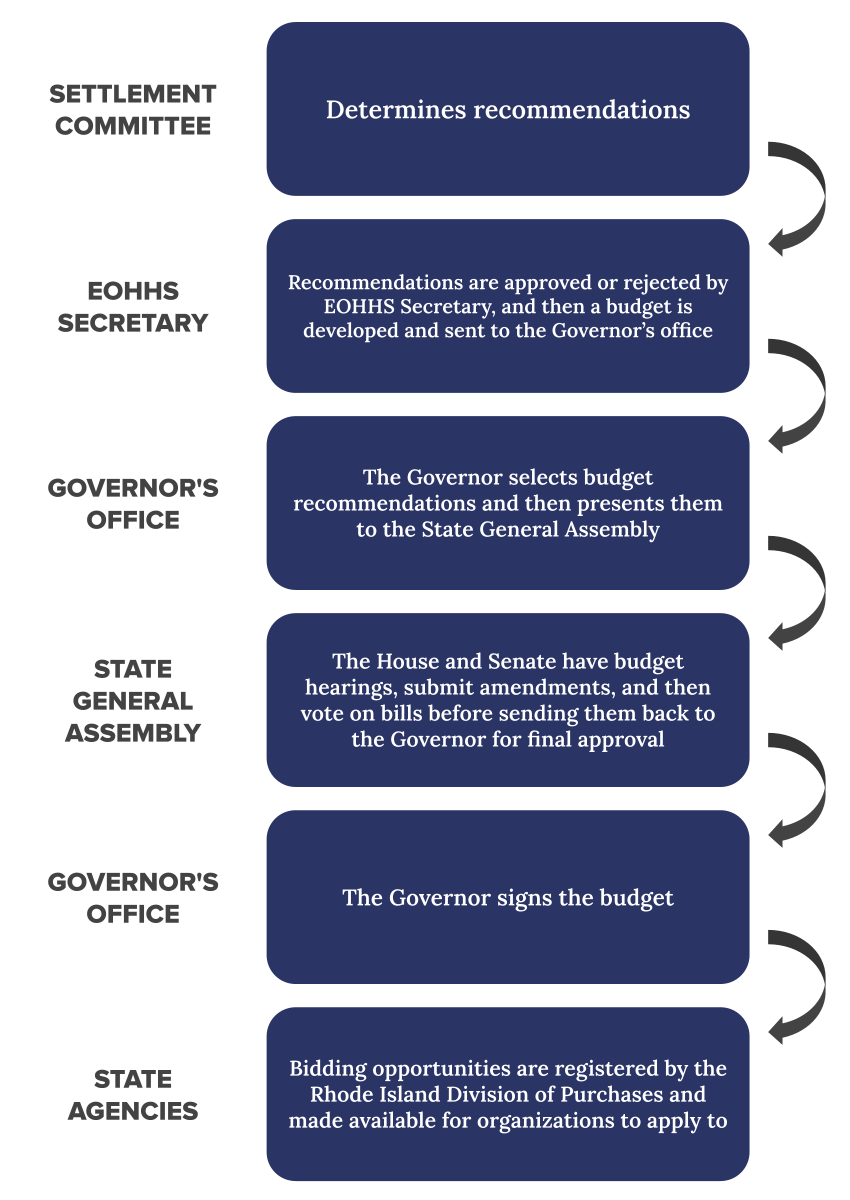
Opioid Settlement Advisory Committee recommends, Executive Office of Health and Human Services and Governor select, state legislature appropriates. Specific expenditures for this share are made using a multi-step process involving several state entities:[8]
Opioid Settlement Advisory Committee. The is required to create a process for gathering input from communities, provider organizations, and localities,[9] then annually recommending uses of the statewide abatement share to the Secretary of the Rhode Island Executive Office of Health and Human Services.[10]
EOHHS Secretary. The of the Rhode Island Executive Office of Health and Human Services (EOHHS) must make a “good faith effort” to incorporate the Advisory Committee’s recommendations into EOHHS’s annual budget.[11] If EOHHS “substantially deviates” from the Advisory Committee’s recommendations, it must provide a public written explanation.[12] Recommendations are ultimately “approved or rejected by the EOHHS Secretary, … then a budget is developed and sent to the Governor’s office.”[13]
Governor’s office. The selects recommendations for inclusion in their budget to be considered by the Rhode Island legislature.[14]
State general assembly. The passes a budget and sends it back to the Governor for final approval.[15]
After the Governor signs the budget, EOHHS coordinates with various state agencies to carry out planning and implementation of opioid abatement activities.”[16]
No, supplantation is not prohibited. Like most states, Rhode Island does not explicitly prohibit supplantation uses of its opioid settlement funds. This means that the Statewide Abatement share may be spent in ways that replace (or “supplant”) — rather than supplement — existing resources.
Yes (public reporting not required, only intrastate). View annual reports on the Advisory Committee’s . Rhode Island has also published expenditure information via a .[17] The state’s MOU requires the Secretary of EOHHS to submit an annual report to the Advisory Committee on the distribution and use of funds from this share.[18]
Visit OpioidSettlementTracker.com’s for an updated collection of states’ and localities’ available expenditure reports.
Not applicable.
(80% of funds paid directly to the State (‘Statewide Abatement Share’) and held in the Rhode Island Statewide Opioid Abatement Account). See also (the Statewide Abatement Account has the “restricted purpose of holding these funds separately, ensuring they are not comingled with non-Opioid Settlement Funds, and distributing the funds for Approved Purposes”). R.I. Gen. Laws Sec. 42-7.2-10(d) (“There is hereby created within the general fund of the state and housed within the budget of the office of health and human services a restricted receipt account entitled ‘Rhode Island Statewide Opioid Abatement Account’”). ↑
(“Qualifying expenditures may include reasonable related administrative expenses”) and (defining “Opioid Settlement Funds” to exclude “funds needed to pay an administrator or a Rhode Island Qualified Settlement Administrator, or designated by a Settlement Agreement or court order for State or Participating Subdivision attorneys’ fees and costs”). ↑
. ↑
R.I. Gen. Laws Sec. 42-7.2-10(d) (“There is hereby created within the general fund of the state and housed within the budget of the office of health and human services a restricted receipt account entitled ‘Rhode Island Statewide Opioid Abatement Account,’” and “[f]unds from this account shall only be used for forward-looking opioid abatement efforts as defined and limited by any settlement agreements, state-city and town agreements, or court orders pertaining to the use of such funds”) and (“The Statewide Abatement Share shall be used for forward-looking Approved Purposes only”). ↑
. Prevent Overdose RI (PORI). Accessed August 25, 2024 (“ as a roadmap to recommend the distribution of these funds throughout the state. We have already utilized this plan to guide millions of dollars in statewide and investments. The Action Plan is also helping us make sure that funds are equitably distributed, taking into consideration the history of structural racism and its impact on health”). ↑
. PORI. Accessed August 25, 2024. See also . PORI. Accessed August 25, 2024. ↑
. PORI. April 26, 2024. Accessed August 25, 2024. See also . PORI. Accessed August 25, 2024. (“The OSAC first convened in April 2022. Each year, OSAC recommends areas to focus on and approves a funding budget drafted for them by State staff. Next, they present the budget to the Secretary of the Executive Office of Health and Human Services. The Secretary can accept the budget or talk with OSAC to make changes to it. Lastly, the Secretary presents the final budget to the Governor. The Governor puts it in their budget to be considered by the General Assembly. You can ”). ↑
.This subsection also encourages but does not require the Advisory Committee to coordinate with established government bodies and organizations working to address overdose, including the Governor’s Overdose Prevention and Intervention Task Force and harm reduction organizations. ↑
(describing the annual submission of spending recommendations and that “[t]o aid the Advisory Committee in formulating the Statewide Abatement Recommendations, EOHHS, RIDOH, and BHDDH shall present information regarding the State’s opioid abatement strategy and appropriations plan, and information on how that strategy responds to the opioids crisis and the abatement needs of Rhode Island’s communities. The Advisory Committee may also consider how non-Opioid Settlement Funds are used as part of the State’s opioid abatement strategy when formulating the Statewide Abatement Recommendations”). ↑
(“The Secretary shall review and consider the Statewide Abatement Recommendations and shall make a good faith effort to incorporate the Statewide Abatement Recommendations into EOHHS’s annual budget process”). ↑
(“If the Secretary substantially deviates from the Statewide Abatement Recommendations, the Secretary shall provide the Advisory Committee with a written explanation, that will be made public, of any substantial deviations”). ↑
PORI: . ↑
(“at least annually the Secretary [of EOHHS] shall present to the Governor, for inclusion in the Governor’s budget presentation to the General Assembly, the Secretary’s recommendations on the use of the Statewide Abatement Share”). See also . PORI. Accessed August 25, 2024 (“The Governor selects budget recommendations and then presents them to the State General Assembly”). ↑
. PORI. Accessed August 25, 2024 (“The House and Senate have budget hearings, submit amendments, and then vote on bills before sending them back to the Governor for final approval”). See also . PORI. Accessed September 1, 2024. ↑
. EOHHS. December 27, 2023. Accessed August 25, 2024 (“EOHHS works closely with the Department of Behavioral Healthcare, Developmental Disabilities, and Hospitals (BHDDH) and the Rhode Island Department of Health (RIDOH), along with the Department of Corrections, the Department of Housing, and other state agencies to carry out planning and implementation of opioid abatement activities”). ↑
. EOHHS. December 27, 2023. Accessed August 25, 2024. . EOHHS. January 3, 2023. Accessed August 25, 2024. ↑
. ↑